
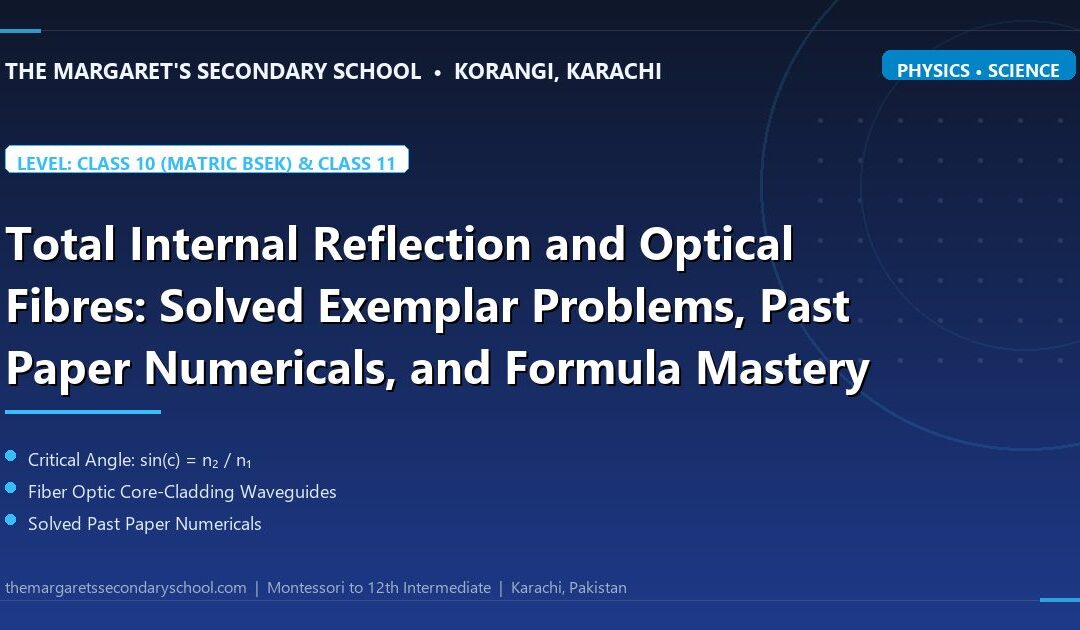
Academic Level: Class 10 (Matric BSEK) & Class 11 |
Subject: Optics |
Institution: The Margaret’s Secondary School, Korangi, Karachi
Curriculum focus aligned with the Sindh Textbook Board, BSEK Matriculation, and BIEK Intermediate syllabus.
A comprehensive academic study guide for Class 10 (Matric BSEK) & Class 11 covering Total Internal Reflection and Optical Fibres. Explores Snell’s law, critical angle conditions, and light propagation through optical fiber communication cables. with specific alignment to the Sindh Textbook Board syllabus at The Margaret’s Secondary School, Korangi, Karachi.
Introduction to Total Internal Reflection and Optical Fibres
When light travels from an optically denser medium into an optically rarer medium, it bends away from the normal. At a specific threshold known as the critical angle, the refracted ray skims the interface at 90 degrees, opening the doorway to total internal reflection.
Core Principles and Analytical Framework
Total internal reflection occurs when: 1) Light travels from denser to rarer medium, and 2) Angle of incidence exceeds critical angle (i > c). The critical angle formula is sin(c) = n₂ / n₁. In fiber optics, light undergoes continuous total internal reflection inside a high-index glass core.
Step-by-Step Solved Karachi Board Exemplar Questions
Consistent practice with past-paper numericals builds problem-solving confidence. Sindh Board marking schemes allocate separate marks for stating given data, formula selection, step calculation, and unit notation.
- Core Academic Focus: Snell’s law, critical angle conditions, and light propagation through optical fiber communication cables.
- Curriculum Context: Aligned with the Board of Secondary Education Karachi (BSEK) and Board of Intermediate Education Karachi (BIEK) examinations.
- Classroom Implementation: Taught with interactive laboratory demonstrations and structured problem-solving sessions at The Margaret’s Secondary School, Korangi, Karachi.
Examination Strategies and Sindh Board Marking Scheme
In numerical questions, never skip intermediate calculation steps. Examiners award partial step-marking even if an arithmetic calculation error occurs at the end.
Consistent weekly revision, neat presentation of answers, and thorough review of five-year past papers guarantee exceptional academic distinction.
🎓 Key Academic Takeaways & Exam Strategies
- Review key terminology, formulas, and definitions on a weekly basis.
- Practice writing answers in neat bullet points to maximize marks in Board examinations.
- Consult with your subject teachers at The Margaret’s Secondary School for additional past-paper guidance and laboratory demonstrations.
Frequently Asked Questions (FAQs)
Q: What is the critical angle for water-air and glass-air interfaces?
Ans: For water-air it is approximately 48.6°, and for crown glass-air it is approximately 42°.
Q: Why does fiber optic cable use cladding with a lower refractive index?
Ans: A lower refractive index in the cladding ensures light reflects back into the core, preventing optical signal leakage.
Related posts:
 Simple Harmonic Motion and Waves: The Beauty of Oscillation
Exploring the Fascinating World of Sound Waves: Types and Characteristics
Simple Harmonic Motion and Waves: The Beauty of Oscillation
Exploring the Fascinating World of Sound Waves: Types and Characteristics
 Total Internal Reflection and Optical Fibres: Principles, Critical Angle, and High-Speed Internet
 Vector Addition by Rectangular Components: Theoretical Principles, Core Proofs, and Karachi Board Derivations