
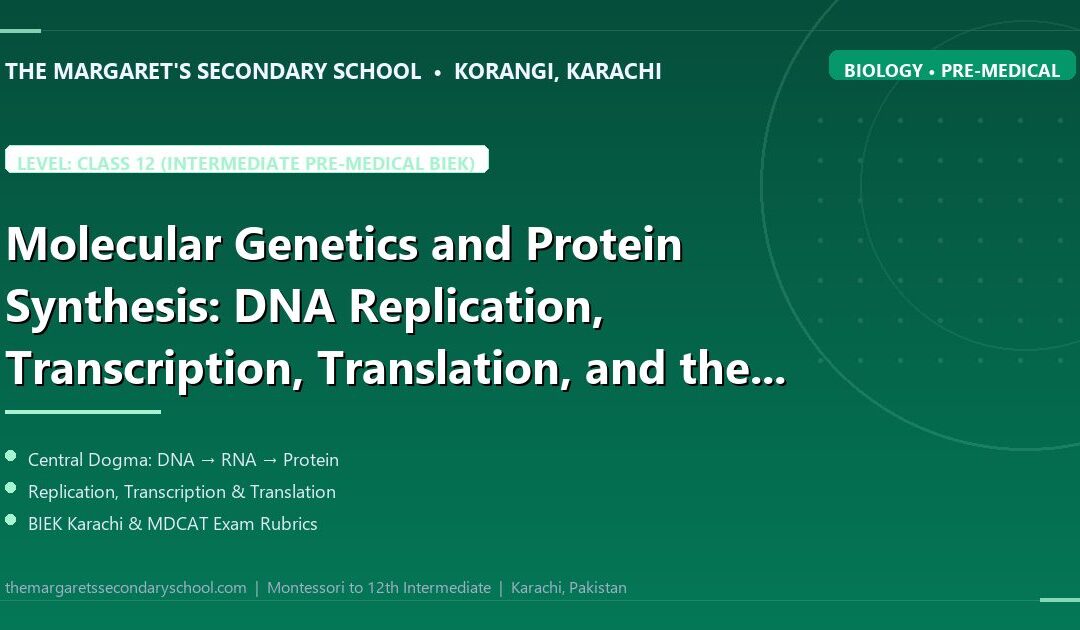
Academic Level: Class 12 (Intermediate Pre-Medical BIEK) |
Subject: Biology |
Institution: The Margaret’s Secondary School, Korangi, Karachi
Curriculum focus aligned with the Sindh Textbook Board, BSEK Matriculation, and BIEK Intermediate syllabus.
A masterclass study guide on molecular genetics and protein synthesis for Karachi Board Pre-Medical students, detailing the Central Dogma, semi-conservative DNA replication, mRNA transcription, ribosomal translation, and high-yield scoring strategies for BIEK and MDCAT examinations.
The Central Dogma of Molecular Biology: From Nucleic Acids to Functional Polypeptides
In 1958, Nobel laureate Francis Crick articulated the unifying framework of modern biochemistry: The Central Dogma of Molecular Biology. It posits that genetic information stored within double-stranded deoxyribonucleic acid (DNA) is faithfully transcribed into messenger RNA (mRNA), which is subsequently translated into functional enzymatic and structural proteins: DNA → RNA → Protein.
In the Board of Intermediate Education Karachi (BIEK) Class 12 Pre-Medical syllabus and the National MDCAT (Medical & Dental Colleges Admission Test), molecular genetics constitutes one of the most intellectually demanding and heavily weighted examination modules. A profound conceptual mastery of nucleic acid architecture is indispensable for understanding hereditary transmission, congenital genetic disorders, and modern biotechnology.
| Biochemical Feature | Deoxyribonucleic Acid (DNA) | Ribonucleic Acid (RNA) |
|---|---|---|
| Pentose Sugar | 2-Deoxyribose (lacks 2′-OH group) | Ribose (contains reactive 2′-OH group) |
| Nitrogenous Bases | Adenine (A), Guanine (G), Cytosine (C), Thymine (T) | Adenine (A), Guanine (G), Cytosine (C), Uracil (U) |
| Structural Form | Antiparallel Double Helix (B-DNA form) | Predominantly Single-Stranded (mRNA, tRNA, rRNA) |
| Chemical Stability | High: Stable genetic storehouse resistant to alkaline hydrolysis | Moderate: Transient intermediary degraded rapidly by cellular RNases |
Mechanics of DNA Replication: The Semi-Conservative Replisome Machinery
Prior to mitotic cell division, a diploid cell must duplicate its genomic blueprint with near-perfect fidelity (less than 1 error per 10⁹ base pairs). In 1958, Matthew Meselson and Franklin Stahl verified through isotopic nitrogen (¹⁵N / ¹⁴N) density gradient centrifugation that DNA replicates via a semi-conservative mechanism: each daughter duplex retains one conserved parental template strand and one newly synthesized nascent strand.
The molecular choreography of the replication fork involves a multi-enzyme replisome complex:
- DNA Helicase: Hydrolyzes ATP to unwind the hydrogen-bonded base pairs, creating a dynamic Y-shaped replication fork.
- Single-Stranded Binding Proteins (SSBs): Stabilize the unwound single strands, preventing premature re-annealing and hairpin loop formation.
- DNA Topoisomerase (Gyrase): Relieves supercoiling and positive torsional strain introduced ahead of the advancing replication fork.
- RNA Primase: Synthesizes a transient 10-base RNA primer, providing the mandatory free 3′-OH group required by polymerase.
- DNA Polymerase III: The principal catalytic replicase. It reads the parental template in the 3′ → 5′ direction and synthesizes nascent DNA strictly in the 5′ → 3′ direction:
- Leading Strand: Synthesized continuously toward the progressing replication fork.
- Lagging Strand: Synthesized discontinuously away from the fork in short 1,000–2,000 nucleotide segments called Okazaki Fragments.
- DNA Polymerase I & DNA Ligase: DNA Polymerase I hydrolyzes the RNA primers with its 5′ → 3′ exonuclease activity and fills the resulting gaps with deoxynucleotides; DNA Ligase then catalyzes the formation of covalent phosphodiester bonds to seal the remaining nicks.
Transcription and Translation: Decoding Genetic Information into Proteins
Gene expression translates abstract nucleic acid sequences into three-dimensional enzymatic and structural proteins through two coordinated stages:
Stage 1: Transcription (DNA to mRNA)
During transcription, RNA Polymerase recognizes a specific promoter sequence (the TATA box located upstream of the transcription start site). Unlike DNA replication, only one strand—the Antisense (Template) Strand (3′ → 5′)—is transcribed, producing a single-stranded pre-mRNA complementary to the template and identical to the Coding (Sense) Strand (with Uracil replacing Thymine). In eukaryotic cells, the primary transcript undergoes essential post-transcriptional modifications: addition of a 7-methylguanosine cap at the 5′ end, a poly-A tail at the 3′ end, and spliceosomal splicing to remove non-coding introns while ligating coding exons.
Stage 2: The Universal Triplet Genetic Code
Information on mRNA is read in consecutive non-overlapping triplets of nucleotides called Codons. The genetic code exhibits four fundamental universal properties:
- Triplet Nature: 4³ = 64 possible codons specify 20 standard amino acids and regulatory signals.
- Degeneracy (Redundancy): Multiple distinct codons can code for the identical amino acid (e.g., UUU and UUC both specify Phenylalanine), buffering against silent mutations.
- Start and Stop Codons: AUG serves as the universal initiation codon (coding for Methionine), while UAA (Ochre), UAG (Amber), and UGA (Opal) are non-sense termination codons that trigger release factor binding.
- Universality: The identical codon translates into the identical amino acid across virtually all living organisms—from E. coli to human beings—providing profound molecular evidence for shared evolutionary heritage.
Stage 3: Translation at the Ribosome
Ribosomal subunits (comprising rRNA and proteins) assemble around the mature mRNA. Transfer RNA (tRNA) molecules—possessing a specific 3′-CCA amino acid attachment arm and a complementary three-base anticodon loop—deliver amino acids to the ribosomal A (Aminoacyl) site, form peptide bonds catalyzed by the Peptidyl Transferase ribozyme at the P (Peptidyl) site, and exit via the E (Exit) site, elongating the growing polypeptide chain.
Karachi Board Examination Tips and MDCAT Medical Entry Test High-Yield Review
In BIEK Karachi Intermediate Pre-Medical examinations and the National MDCAT, molecular genetics questions test precision, biochemical terminology, and diagrammatic clarity:
- Replication Fork Diagrams: In Section C descriptive questions, always draw a neat, pencil-sketched replication fork clearly marking the 5′ and 3′ polarities of both parental strands, the continuous leading strand, and discontinuous Okazaki fragments with RNA primers. Unlabeled 5’/3′ ends result in automatic mark deductions.
- Mutational Analysis for MDCAT: Distinguish between Transition (purine to purine or pyrimidine to pyrimidine) vs. Transversion (purine to pyrimidine), and understand how single-base insertions or deletions cause catastrophic Frameshift Mutations that completely alter downstream amino acid reading frames.
- Laboratory Practical Training: At The Margaret’s Secondary School in Korangi, Karachi, Pre-Medical students conduct hands-on DNA spooling and precipitation protocols using modern micropipettes, chilled ethanol, and ionic detergents, reinforcing textbook molecular biology through direct laboratory visualization.
🎓 Key Academic Takeaways & Exam Strategies
- Review key terminology, formulas, and definitions on a weekly basis.
- Practice writing answers in neat bullet points to maximize marks in Board examinations.
- Consult with your subject teachers at The Margaret’s Secondary School for additional past-paper guidance and laboratory demonstrations.
Frequently Asked Questions (FAQs)
Q: Why can DNA Polymerase only synthesize new DNA strands in the 5′ to 3′ direction?
Ans: DNA Polymerase requires a free 3′-hydroxyl (-OH) group on the preceding nucleotide to attack the incoming deoxynucleoside triphosphate (dNTP) and form a covalent phosphodiester bond. Because the enzyme’s catalytic active site cannot add nucleotides to a 5′-phosphate terminus, chain elongation proceeds exclusively in the 5′ to 3′ direction.
Q: What does it mean that the genetic code is ‘degenerate’ or ‘redundant’?
Ans: There are 64 possible triplet codons but only 20 standard amino acids. ‘Degeneracy’ means that several different codons can code for the same amino acid (for example, six distinct codons code for Leucine). This redundancy provides an essential evolutionary buffer against harmful point mutations.
Q: What is the difference between an Intron and an Exon in eukaryotic genetics?
Ans: Exons are coding sequences of pre-mRNA that are spliced together, retained in the mature transcript, and translated into functional protein. Introns are intervening non-coding sequences that are excised and degraded by spliceosomes before mRNA export through the nuclear pore complex.
Related posts:
 The Science and Benefits of Inhalation: Breathing Life into Health
The Breath of Life: Exploring the Science and Significance of Exhalation
Understanding Respiratory Disorders: Causes, Symptoms, and Management
The Science and Benefits of Inhalation: Breathing Life into Health
The Breath of Life: Exploring the Science and Significance of Exhalation
Understanding Respiratory Disorders: Causes, Symptoms, and Management
 Mitosis vs Meiosis and Genetic Variation: Laboratory Protocols, Practical Verification, and Viva Voce Preparation