
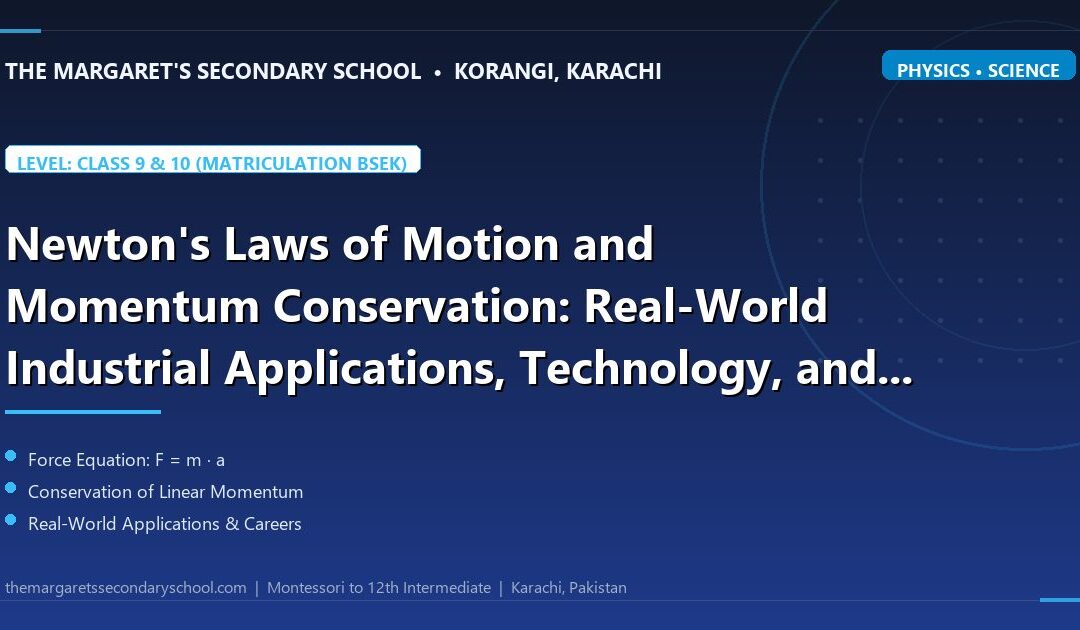
Academic Level: Class 9 & 10 (Matriculation BSEK) |
Subject: Mechanics |
Institution: The Margaret’s Secondary School, Korangi, Karachi
Curriculum focus aligned with the Sindh Textbook Board, BSEK Matriculation, and BIEK Intermediate syllabus.
A comprehensive academic study guide for Class 9 & 10 (Matriculation BSEK) covering Newton’s Laws of Motion and Momentum Conservation. Explores Inertia, force-acceleration relation (F=ma), action-reaction pairs, and linear momentum conservation in collisions. with specific alignment to the Sindh Textbook Board syllabus at The Margaret’s Secondary School, Korangi, Karachi.
Introduction to Newton’s Laws of Motion and Momentum Conservation
Sir Isaac Newton formulated the three laws of motion that constitute classical Newtonian mechanics. In the BSEK Karachi syllabus, these laws explain planetary orbits, automotive safety, projectile trajectories, and rocket propulsion.
Core Principles and Analytical Framework
Newton’s Second Law states that net force equals the rate of change of linear momentum: F = dp/dt = m·a. The Law of Conservation of Momentum dictates that in an isolated system, total initial momentum equals total final momentum (m₁u₁ + m₂u₂ = m₁v₁ + m₂v₂).
Contemporary Industrial Applications, Pakistan Case Studies, and Future Careers
Connecting classroom curriculum concepts to contemporary industrial practice, technological innovations in Pakistan, and prospective career paths empowers students to visualize real-world impact.
- Core Academic Focus: Inertia, force-acceleration relation (F=ma), action-reaction pairs, and linear momentum conservation in collisions.
- Curriculum Context: Aligned with the Board of Secondary Education Karachi (BSEK) and Board of Intermediate Education Karachi (BIEK) examinations.
- Classroom Implementation: Taught with interactive laboratory demonstrations and structured problem-solving sessions at The Margaret’s Secondary School, Korangi, Karachi.
Examination Strategies and Sindh Board Marking Scheme
Examiners award bonus marks for citing contemporary practical applications and industrial examples in Karachi and Pakistan.
Consistent weekly revision, neat presentation of answers, and thorough review of five-year past papers guarantee exceptional academic distinction.
🎓 Key Academic Takeaways & Exam Strategies
- Review key terminology, formulas, and definitions on a weekly basis.
- Practice writing answers in neat bullet points to maximize marks in Board examinations.
- Consult with your subject teachers at The Margaret’s Secondary School for additional past-paper guidance and laboratory demonstrations.
Frequently Asked Questions (FAQs)
Q: Why do modern cars feature crumple zones?
Ans: Crumple zones increase collision impact time (Δt), thereby reducing the impact force (F = Δp / Δt) experienced by passengers.
Q: Do action and reaction forces cancel each other out?
Ans: No, because action and reaction act on two entirely different bodies simultaneously.
Related posts:
 The Nature of Sound Waves: Unveiling the Symphony of Vibrations
The Science of Echo: Understanding Its Origin and Phenomenon
 The First Law of Thermodynamics and Heat Engines: Theoretical Principles, Core Proofs, and Karachi Board Derivations
 Total Internal Reflection and Optical Fibres: Real-World Industrial Applications, Technology, and Future Careers