
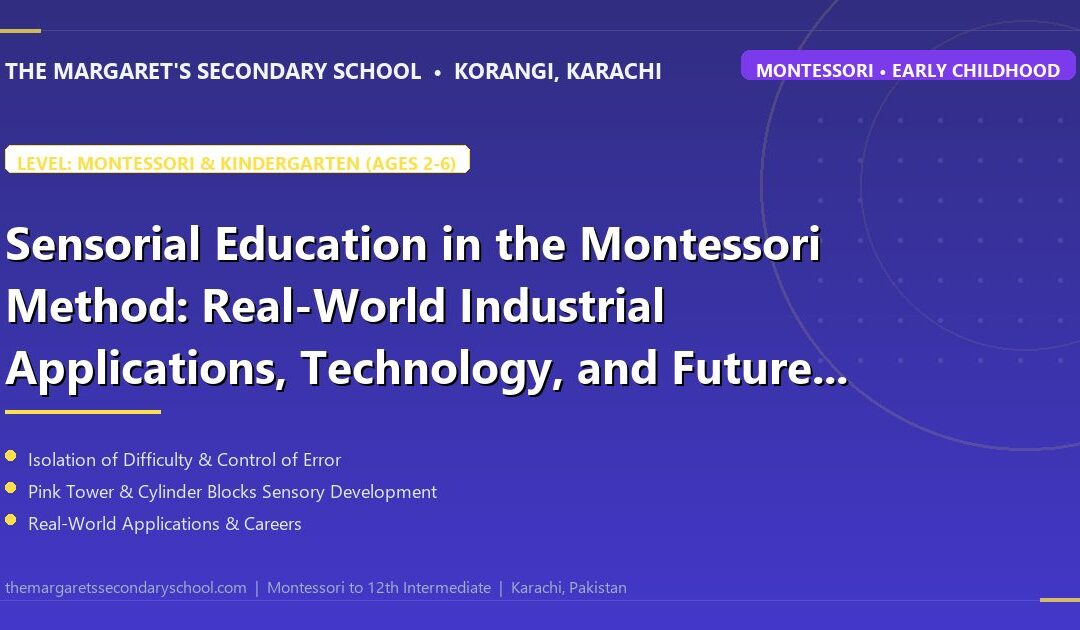
Academic Level: Montessori & Kindergarten (Ages 2-6) |
Subject: Early Childhood Pedagogy |
Institution: The Margaret’s Secondary School, Korangi, Karachi
Curriculum focus aligned with the Sindh Textbook Board, BSEK Matriculation, and BIEK Intermediate syllabus.
A comprehensive academic study guide for Montessori & Kindergarten (Ages 2-6) covering Sensorial Education in the Montessori Method. Explores Refining sensory perception through didactic materials: Pink Tower, Cylinder Blocks, Color Tablets, and Sound Cylinders for intellectual clarity. with specific alignment to the Sindh Textbook Board syllabus at The Margaret’s Secondary School, Korangi, Karachi.
Introduction to Sensorial Education in the Montessori Method
Dr. Maria Montessori recognized that early childhood is characterized by an ‘absorbent mind’. Sensorial education isolates single physical properties—dimensions, textures, weights, sounds, and colors—empowering children to organize environmental impressions into classified mental frameworks.
Core Principles and Analytical Framework
Key apparatus include: 1) The Pink Tower: Ten wooden cubes progressing from 1cm³ to 10cm³, building 3D visual perception. 2) Cylinder Blocks: Wooden blocks with matching knobbed cylinders teaching fine pincer grasp and dimensional seriation. 3) Sandpaper Letters: Tactile muscle-memory integration preceding written literacy.
Contemporary Industrial Applications, Pakistan Case Studies, and Future Careers
Connecting classroom curriculum concepts to contemporary industrial practice, technological innovations in Pakistan, and prospective career paths empowers students to visualize real-world impact.
- Core Academic Focus: Refining sensory perception through didactic materials: Pink Tower, Cylinder Blocks, Color Tablets, and Sound Cylinders for intellectual clarity.
- Curriculum Context: Aligned with the Board of Secondary Education Karachi (BSEK) and Board of Intermediate Education Karachi (BIEK) examinations.
- Classroom Implementation: Taught with interactive laboratory demonstrations and structured problem-solving sessions at The Margaret’s Secondary School, Korangi, Karachi.
Examination Strategies and Sindh Board Marking Scheme
Examiners award bonus marks for citing contemporary practical applications and industrial examples in Karachi and Pakistan.
Consistent weekly revision, neat presentation of answers, and thorough review of five-year past papers guarantee exceptional academic distinction.
🎓 Key Academic Takeaways & Exam Strategies
- Review key terminology, formulas, and definitions on a weekly basis.
- Practice writing answers in neat bullet points to maximize marks in Board examinations.
- Consult with your subject teachers at The Margaret’s Secondary School for additional past-paper guidance and laboratory demonstrations.
Frequently Asked Questions (FAQs)
Q: Why are Montessori sensorial materials designed with a ‘control of error’?
Ans: A built-in control of error enables the child to self-correct mistakes independently without relying on adult critique, fostering intrinsic motivation.
Q: How does sensorial play prepare toddlers for abstract mathematics?
Ans: Handling sets of 10 blocks, rods, and bead bars embeds subconscious neurological templates for the base-ten decimal number system.
Related posts:
 Phonics and Sensory Learning: Nurturing Early Reading and Motor Skills in Montessori Education
Phonics and Sensory Learning: Nurturing Early Reading and Motor Skills in Montessori Education
Phonics and Sensory Learning: Nurturing Early Reading and Motor Skills in Montessori Education
 Phonics and Sensory Learning: Nurturing Early Reading and Motor Skills in Montessori Education
Sensorial Education in the Montessori Method: Refining the Senses for Intellectual Growth
Phonics and Sensory Learning: Nurturing Early Reading and Motor Skills in Montessori Education
Sensorial Education in the Montessori Method: Refining the Senses for Intellectual Growth