
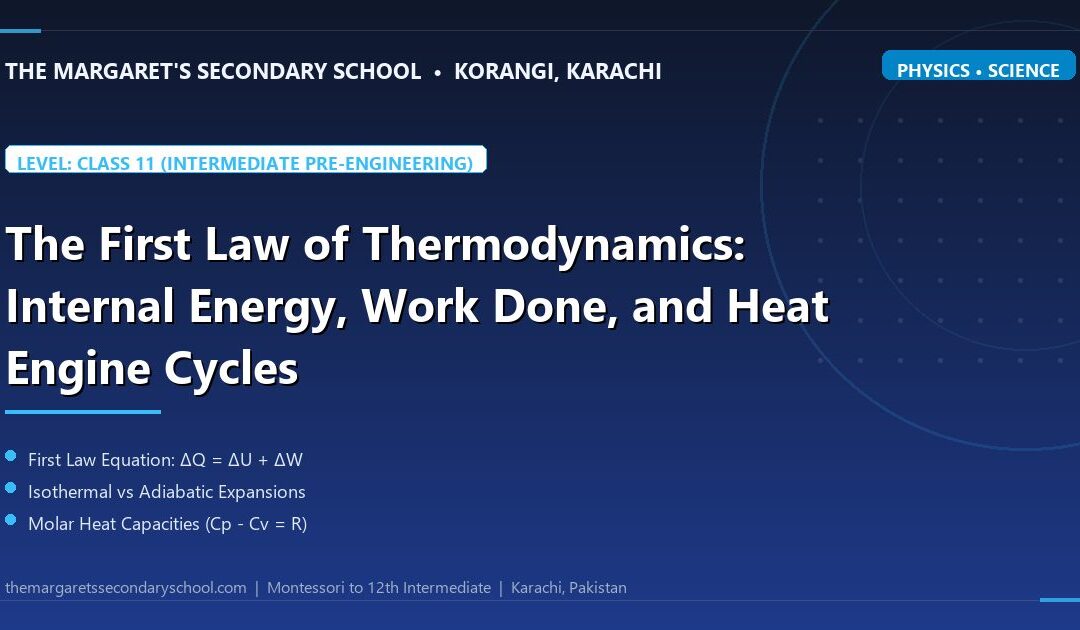
Academic Level: Class 11 (Intermediate Pre-Engineering) |
Subject: Thermodynamics |
Institution: The Margaret’s Secondary School, Korangi, Karachi
Curriculum focus aligned with the Sindh Textbook Board, BSEK Matriculation, and BIEK Intermediate syllabus.
Detailed study of thermodynamics for intermediate physics students, exploring isothermal and adiabatic processes, molar specific heats, and the First Law formula.
Thermodynamic Systems and State Variables
The First Law of Thermodynamics is an extension of the law of conservation of energy: ΔQ = ΔU + ΔW.
The First Law of Thermodynamics Explained
Work done by an expanding gas at constant pressure P is given by ΔW = P * ΔV.
Isothermal vs Adiabatic Processes
In an isothermal process, temperature remains constant (ΔU = 0), so all added heat converts into work: ΔQ = ΔW.
Proof that Cp – Cv = R for Ideal Gases
In an adiabatic process, no heat enters or leaves (ΔQ = 0), so work is done entirely at the expense of internal energy: ΔW = -ΔU.
🎓 Key Academic Takeaways & Exam Strategies
- Review key terminology, formulas, and definitions on a weekly basis.
- Practice writing answers in neat bullet points to maximize marks in Board examinations.
- Consult with your subject teachers at The Margaret’s Secondary School for additional past-paper guidance and laboratory demonstrations.
Frequently Asked Questions (FAQs)
Q: Why is Cp always greater than Cv?
Ans: At constant pressure, gas expands and does external work, requiring extra heat to achieve the same temperature rise.
Q: What is an adiabatic process?
Ans: A thermodynamic process in which no heat enters or leaves the system (Q = 0), typically occurring very rapidly.
Related posts:
 The Importance of Acoustic Protection: Preserving Health and Well-Being
Vector Addition by Rectangular Components: Complete Derivation and Board Numericals
The Importance of Acoustic Protection: Preserving Health and Well-Being
Vector Addition by Rectangular Components: Complete Derivation and Board Numericals
 Vector Addition by Rectangular Components: Complete Derivation and Board Numericals
 Newton’s Three Laws of Motion: Comprehensive Principles, Formulae, and Solved Numericals