
Academic Level: Class 9 & 10 (Matric) & Class 11 |
Subject: Fiqh & Social Justice |
Institution: The Margaret’s Secondary School, Korangi, Karachi
Curriculum focus aligned with the Sindh Textbook Board, BSEK Matriculation, and BIEK Intermediate syllabus.
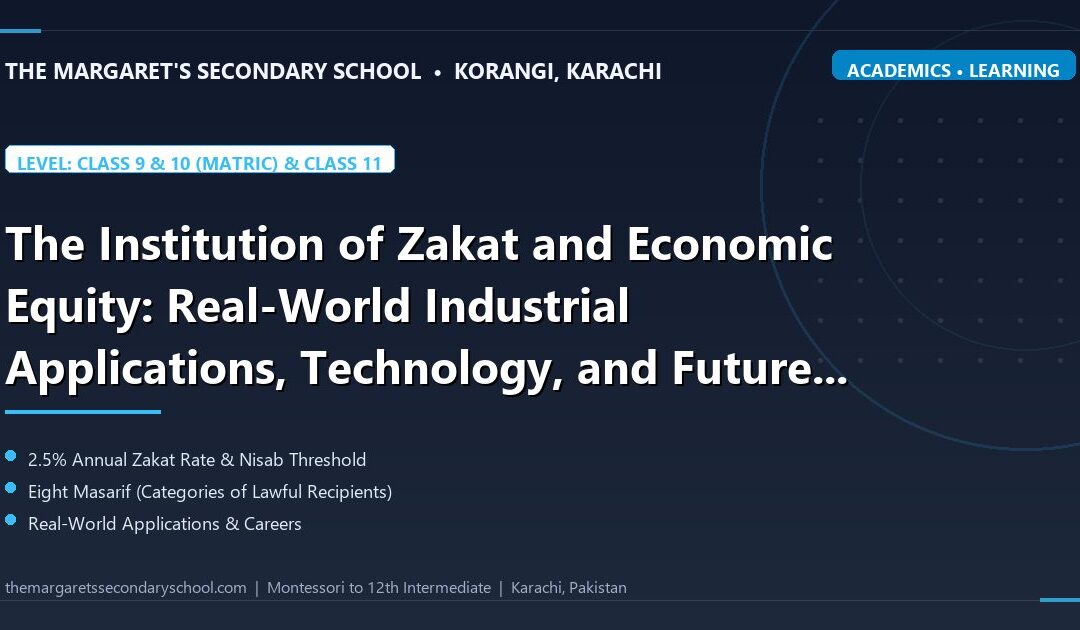
A comprehensive academic study guide for Class 9 & 10 (Matric) & Class 11 covering The Institution of Zakat and Economic Equity. Explores The third pillar of Islam, calculation of Nisab, distribution to eight prescribed categories (Masarif-e-Zakat), and poverty alleviation. with specific alignment to the Sindh Textbook Board syllabus at The Margaret’s Secondary School, Korangi, Karachi.
Introduction to The Institution of Zakat and Economic Equity
Zakat is a mandatory religious obligation and spiritual purification of wealth. In Islamic jurisprudence, it functions as a social security safety net preventing the concentration of capital in a few hands and guaranteeing economic dignity to the vulnerable.
Core Principles and Analytical Framework
Zakat is levied annually at a rate of 2.5% on surplus savings, gold (7.5 tolas), silver (52.5 tolas), and commercial inventory held for a full lunar year (Hawlan al-Hawl). Surah At-Tawbah (9:60) specifies the eight lawful recipients (Masarif): the poor, the needy, administrators, new Muslims, freeing captives, those in debt, in the cause of Allah, and stranded travelers.
Contemporary Industrial Applications, Pakistan Case Studies, and Future Careers
Connecting classroom curriculum concepts to contemporary industrial practice, technological innovations in Pakistan, and prospective career paths empowers students to visualize real-world impact.
- Core Academic Focus: The third pillar of Islam, calculation of Nisab, distribution to eight prescribed categories (Masarif-e-Zakat), and poverty alleviation.
- Curriculum Context: Aligned with the Board of Secondary Education Karachi (BSEK) and Board of Intermediate Education Karachi (BIEK) examinations.
- Classroom Implementation: Taught with interactive laboratory demonstrations and structured problem-solving sessions at The Margaret’s Secondary School, Korangi, Karachi.
Examination Strategies and Sindh Board Marking Scheme
Examiners award bonus marks for citing contemporary practical applications and industrial examples in Karachi and Pakistan.
Consistent weekly revision, neat presentation of answers, and thorough review of five-year past papers guarantee exceptional academic distinction.
🎓 Key Academic Takeaways & Exam Strategies
- Review key terminology, formulas, and definitions on a weekly basis.
- Practice writing answers in neat bullet points to maximize marks in Board examinations.
- Consult with your subject teachers at The Margaret’s Secondary School for additional past-paper guidance and laboratory demonstrations.
Frequently Asked Questions (FAQs)
Q: Can Zakat funds be spent on building mosques or schools?
Ans: According to classical jurisprudence, Zakat requires Tamleek (transferring direct ownership to an eligible individual); operational overheads are funded through general Sadaqah.
Q: How does Zakat stimulate economic circulation?
Ans: By penalizing hoarded idle capital, Zakat incentivizes wealth investment into productive business enterprises, stimulating employment and purchasing power.
Related posts:
 Ethical Values and Social Responsibility in Islam: Truthfulness, Justice, and Community Service
Ethical Values and Social Responsibility in Islam: Truthfulness, Justice, and Community Service
Ethical Values and Social Responsibility in Islam: Truthfulness, Justice, and Community Service
 Ethical Values and Social Responsibility in Islam: Truthfulness, Justice, and Community Service
Ethical Values and Social Responsibility in Islam: Truthfulness, Justice, and Community Service
Ethical Values and Social Responsibility in Islam: Truthfulness, Justice, and Community Service