
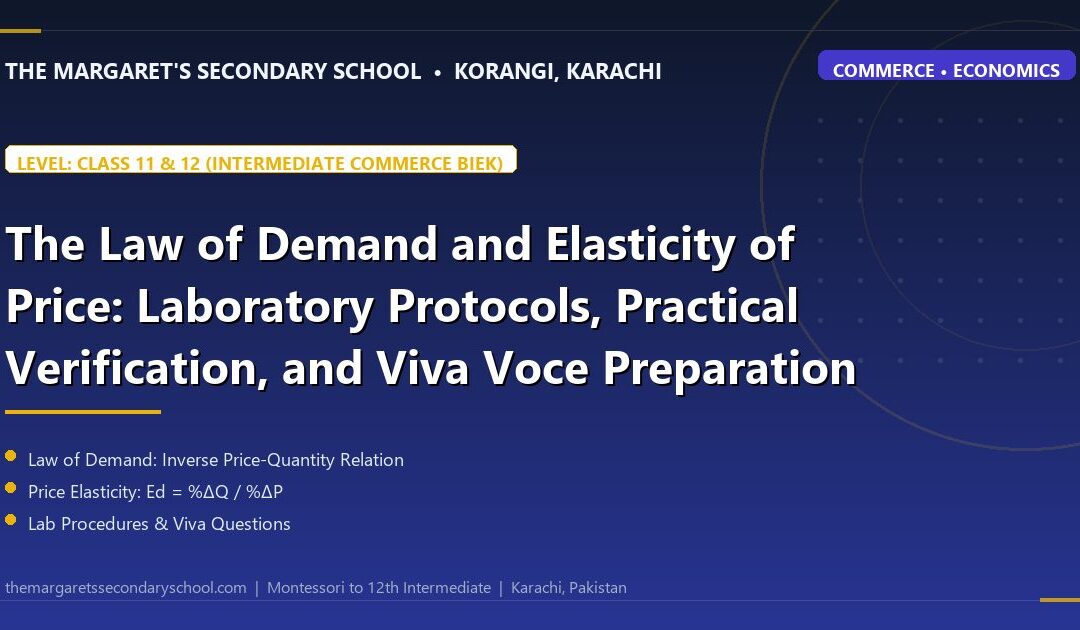
Academic Level: Class 11 & 12 (Intermediate Commerce BIEK) |
Subject: Microeconomics |
Institution: The Margaret’s Secondary School, Korangi, Karachi
Curriculum focus aligned with the Sindh Textbook Board, BSEK Matriculation, and BIEK Intermediate syllabus.
A comprehensive academic study guide for Class 11 & 12 (Intermediate Commerce BIEK) covering The Law of Demand and Elasticity of Price. Explores Inverse price-quantity relationship, downward-sloping demand curve, ceteris paribus assumptions, and calculating price elasticity of demand (Ed). with specific alignment to the Sindh Textbook Board syllabus at The Margaret’s Secondary School, Korangi, Karachi.
Introduction to The Law of Demand and Elasticity of Price
Microeconomics investigates how individual consumers and commercial firms allocate scarce resources. In Class 11 Commerce under BIEK Karachi, the Law of Demand is the cornerstone of price theory, consumer behavior, and commercial market strategies.
Core Principles and Analytical Framework
Law of Demand: Other things being equal (ceteris paribus), as the price of a good increases, quantity demanded decreases, resulting in a downward-sloping demand curve driven by the substitution effect and income effect. Price Elasticity of Demand: Ed = (% Δ in Quantity Demanded) / (% Δ in Price).
Laboratory Protocols, Apparatus Setup, and Viva Voce Guidelines
Practical laboratory sessions transform abstract theory into intuitive empirical understanding. Secondary and intermediate practical examinations test experimental precision, observation recording, and apparatus handling.
- Core Academic Focus: Inverse price-quantity relationship, downward-sloping demand curve, ceteris paribus assumptions, and calculating price elasticity of demand (Ed).
- Curriculum Context: Aligned with the Board of Secondary Education Karachi (BSEK) and Board of Intermediate Education Karachi (BIEK) examinations.
- Classroom Implementation: Taught with interactive laboratory demonstrations and structured problem-solving sessions at The Margaret’s Secondary School, Korangi, Karachi.
Examination Strategies and Sindh Board Marking Scheme
For laboratory exams, always record zero errors of measuring instruments and write units alongside every tabulated observation.
Consistent weekly revision, neat presentation of answers, and thorough review of five-year past papers guarantee exceptional academic distinction.
🎓 Key Academic Takeaways & Exam Strategies
- Review key terminology, formulas, and definitions on a weekly basis.
- Practice writing answers in neat bullet points to maximize marks in Board examinations.
- Consult with your subject teachers at The Margaret’s Secondary School for additional past-paper guidance and laboratory demonstrations.
Frequently Asked Questions (FAQs)
Q: What are Giffen goods and Veblen goods?
Ans: Giffen goods are non-luxury staple items where demand increases as price rises due to extreme poverty; Veblen goods are conspicuous luxury items where high prices enhance prestige.
Q: How does price elasticity guide business pricing decisions in Karachi?
Ans: Inelastic goods (staple foods, medicines) permit higher pricing without significant sales loss, whereas elastic goods require competitive discounts.