
Academic Level: Class 10 (Matriculation BSEK) |
Subject: Algebra |
Institution: The Margaret’s Secondary School, Korangi, Karachi
Curriculum focus aligned with the Sindh Textbook Board, BSEK Matriculation, and BIEK Intermediate syllabus.
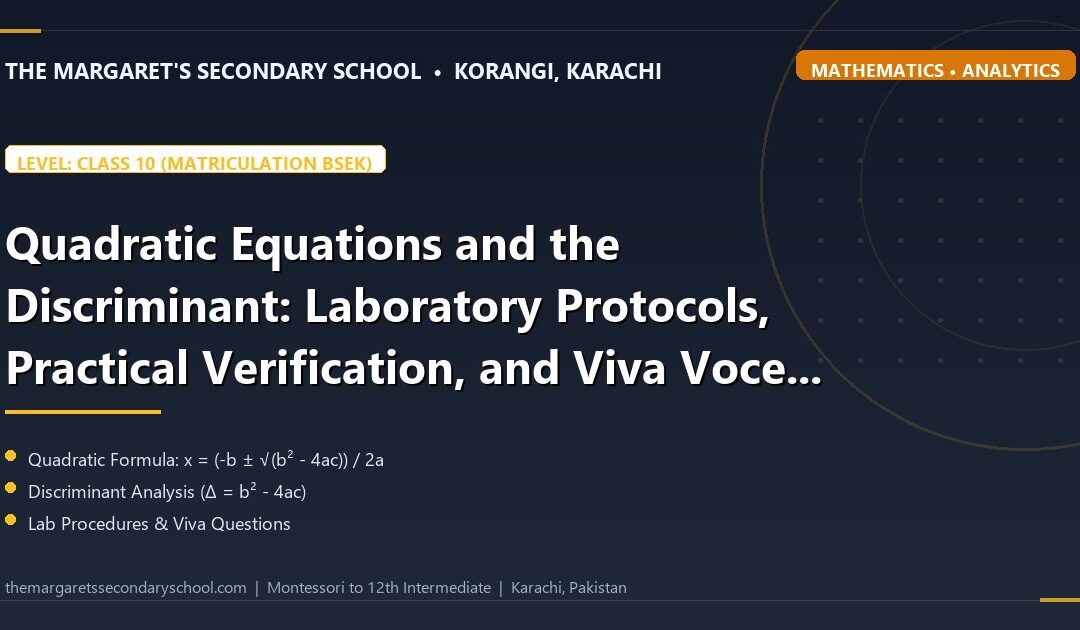
A comprehensive academic study guide for Class 10 (Matriculation BSEK) covering Quadratic Equations and the Discriminant. Explores Standard quadratic form, finding real and complex roots, and nature of roots using the discriminant b^2 – 4ac. with specific alignment to the Sindh Textbook Board syllabus at The Margaret’s Secondary School, Korangi, Karachi.
Introduction to Quadratic Equations and the Discriminant
A quadratic equation is a second-degree polynomial equation of the form ax² + bx + c = 0, where a ≠ 0. In the Board of Secondary Education Karachi (BSEK) syllabus, quadratic equations are foundational to coordinate geometry, kinematics in physics, and algorithmic computing. Students learn to determine roots via factoring, completing the square, and the universal quadratic formula.
Core Principles and Analytical Framework
The discriminant, denoted as Δ = b² – 4ac, dictates the nature of the roots without explicitly solving the equation:
- Δ > 0 and a perfect square: Two distinct, rational roots.
- Δ > 0 and not a perfect square: Two distinct, irrational roots.
- Δ = 0: Exactly one real repeated (equal) root (-b / 2a).
- Δ < 0: Two conjugate complex (imaginary) roots.
Laboratory Protocols, Apparatus Setup, and Viva Voce Guidelines
Practical laboratory sessions transform abstract theory into intuitive empirical understanding. Secondary and intermediate practical examinations test experimental precision, observation recording, and apparatus handling.
- Core Academic Focus: Standard quadratic form, finding real and complex roots, and nature of roots using the discriminant b^2 – 4ac.
- Curriculum Context: Aligned with the Board of Secondary Education Karachi (BSEK) and Board of Intermediate Education Karachi (BIEK) examinations.
- Classroom Implementation: Taught with interactive laboratory demonstrations and structured problem-solving sessions at The Margaret’s Secondary School, Korangi, Karachi.
Examination Strategies and Sindh Board Marking Scheme
For laboratory exams, always record zero errors of measuring instruments and write units alongside every tabulated observation.
Consistent weekly revision, neat presentation of answers, and thorough review of five-year past papers guarantee exceptional academic distinction.
🎓 Key Academic Takeaways & Exam Strategies
- Review key terminology, formulas, and definitions on a weekly basis.
- Practice writing answers in neat bullet points to maximize marks in Board examinations.
- Consult with your subject teachers at The Margaret’s Secondary School for additional past-paper guidance and laboratory demonstrations.
Frequently Asked Questions (FAQs)
Q: What happens when the discriminant is zero in a Karachi board question?
Ans: When Δ = 0, the parabolic curve touches the x-axis at exactly one point, yielding two equal real rational roots.
Q: Can a quadratic equation have one real and one complex root?
Ans: No, because complex roots of real polynomial equations always occur in conjugate pairs (p + iq and p – iq).
Related posts:
 Matrices and Determinants: Addition, Multiplication, and Finding the Inverse by Adjoint Method
 Fundamental Trigonometric Identities: Proofs, Unit Circle Analysis, and Karachi Board Questions
 Fundamental Trigonometric Identities: Proofs, Unit Circle Analysis, and Karachi Board Questions
 Matrices and Determinants: Addition, Multiplication, and Finding the Inverse by Adjoint Method