Academic Level: Class 11 (Intermediate Pre-Engineering) |
Subject: Thermodynamics |
Institution: The Margaret’s Secondary School, Korangi, Karachi
Curriculum focus aligned with the Sindh Textbook Board, BSEK Matriculation, and BIEK Intermediate syllabus.
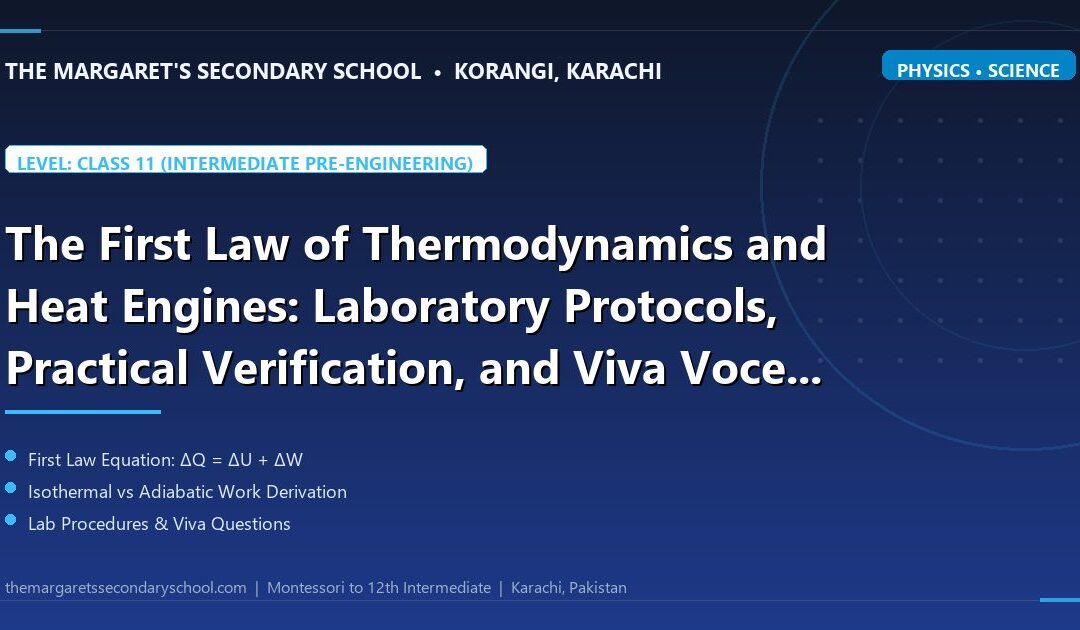
A comprehensive academic study guide for Class 11 (Intermediate Pre-Engineering) covering The First Law of Thermodynamics and Heat Engines. Explores Conservation of energy in thermal systems, isothermal vs adiabatic processes, and molar heat capacities Cp and Cv. with specific alignment to the Sindh Textbook Board syllabus at The Margaret’s Secondary School, Korangi, Karachi.
Introduction to The First Law of Thermodynamics and Heat Engines
Thermodynamics governs energy transformations across mechanical, thermal, and chemical domains. In the Sindh intermediate curriculum, the First Law formalizes the principle of conservation of energy applied to closed thermal systems.
Core Principles and Analytical Framework
The First Law is formulated as ΔQ = ΔU + ΔW, where ΔQ is heat added, ΔU is change in internal energy, and ΔW is work done by expansion (ΔW = P·ΔV). In isothermal expansion (ΔU = 0), ΔQ = ΔW. In adiabatic expansion (ΔQ = 0), ΔW = -ΔU.
Laboratory Protocols, Apparatus Setup, and Viva Voce Guidelines
Practical laboratory sessions transform abstract theory into intuitive empirical understanding. Secondary and intermediate practical examinations test experimental precision, observation recording, and apparatus handling.
- Core Academic Focus: Conservation of energy in thermal systems, isothermal vs adiabatic processes, and molar heat capacities Cp and Cv.
- Curriculum Context: Aligned with the Board of Secondary Education Karachi (BSEK) and Board of Intermediate Education Karachi (BIEK) examinations.
- Classroom Implementation: Taught with interactive laboratory demonstrations and structured problem-solving sessions at The Margaret’s Secondary School, Korangi, Karachi.
Examination Strategies and Sindh Board Marking Scheme
For laboratory exams, always record zero errors of measuring instruments and write units alongside every tabulated observation.
Consistent weekly revision, neat presentation of answers, and thorough review of five-year past papers guarantee exceptional academic distinction.
🎓 Key Academic Takeaways & Exam Strategies
- Review key terminology, formulas, and definitions on a weekly basis.
- Practice writing answers in neat bullet points to maximize marks in Board examinations.
- Consult with your subject teachers at The Margaret’s Secondary School for additional past-paper guidance and laboratory demonstrations.
Frequently Asked Questions (FAQs)
Q: Why is Cp always greater than Cv for ideal gases?
Ans: At constant pressure, gas expands and performs external work, requiring additional heat energy to achieve the same temperature elevation.
Q: What is an adiabatic process?
Ans: A thermodynamic process where no heat enters or leaves the system (Q = 0), occurring rapidly in insulated chambers.