Academic Level: Class 10 & Class 12 (Matric & Inter) |
Subject: Electromagnetism |
Institution: The Margaret’s Secondary School, Korangi, Karachi
Curriculum focus aligned with the Sindh Textbook Board, BSEK Matriculation, and BIEK Intermediate syllabus.
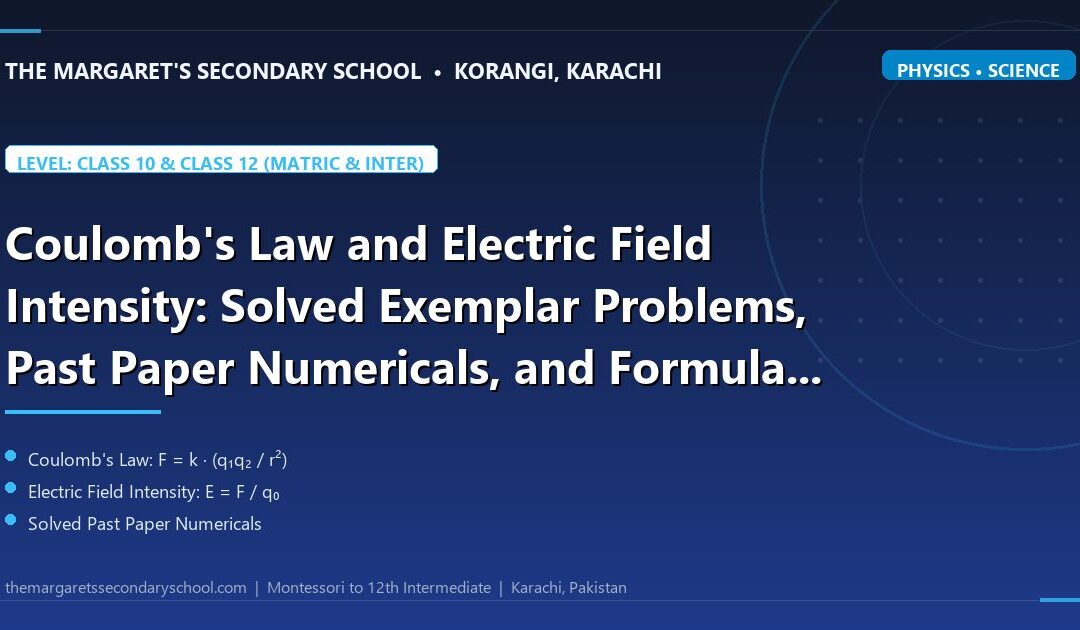
A comprehensive academic study guide for Class 10 & Class 12 (Matric & Inter) covering Coulomb’s Law and Electric Field Intensity. Explores Electrostatic force between point charges, permittivity of free space, electric field lines, and Gauss’s law. with specific alignment to the Sindh Textbook Board syllabus at The Margaret’s Secondary School, Korangi, Karachi.
Introduction to Coulomb’s Law and Electric Field Intensity
Electrostatics explores electrical charges at rest. In both secondary and intermediate physics under the Karachi board, Coulomb’s inverse-square law provides the foundational formula for understanding atomic cohesion, capacitors, and electronic devices.
Core Principles and Analytical Framework
Coulomb’s law states that electrostatic force is proportional to the product of charges and inversely proportional to the square of their separation: F = (1 / 4πε₀) · (q₁q₂ / r²). In SI units, the electrostatic constant k = 8.99 × 10⁹ N·m²/C².
Step-by-Step Solved Karachi Board Exemplar Questions
Consistent practice with past-paper numericals builds problem-solving confidence. Sindh Board marking schemes allocate separate marks for stating given data, formula selection, step calculation, and unit notation.
- Core Academic Focus: Electrostatic force between point charges, permittivity of free space, electric field lines, and Gauss’s law.
- Curriculum Context: Aligned with the Board of Secondary Education Karachi (BSEK) and Board of Intermediate Education Karachi (BIEK) examinations.
- Classroom Implementation: Taught with interactive laboratory demonstrations and structured problem-solving sessions at The Margaret’s Secondary School, Korangi, Karachi.
Examination Strategies and Sindh Board Marking Scheme
In numerical questions, never skip intermediate calculation steps. Examiners award partial step-marking even if an arithmetic calculation error occurs at the end.
Consistent weekly revision, neat presentation of answers, and thorough review of five-year past papers guarantee exceptional academic distinction.
🎓 Key Academic Takeaways & Exam Strategies
- Review key terminology, formulas, and definitions on a weekly basis.
- Practice writing answers in neat bullet points to maximize marks in Board examinations.
- Consult with your subject teachers at The Margaret’s Secondary School for additional past-paper guidance and laboratory demonstrations.
Frequently Asked Questions (FAQs)
Q: What happens to the electrostatic force if a dielectric is inserted between charges?
Ans: The force decreases by a factor equal to the dielectric constant (relative permittivity εr) of the medium.
Q: Can electric field lines ever cross each other?
Ans: No, because at the point of intersection, there would be two different directions for the electric field, which is physically impossible.