
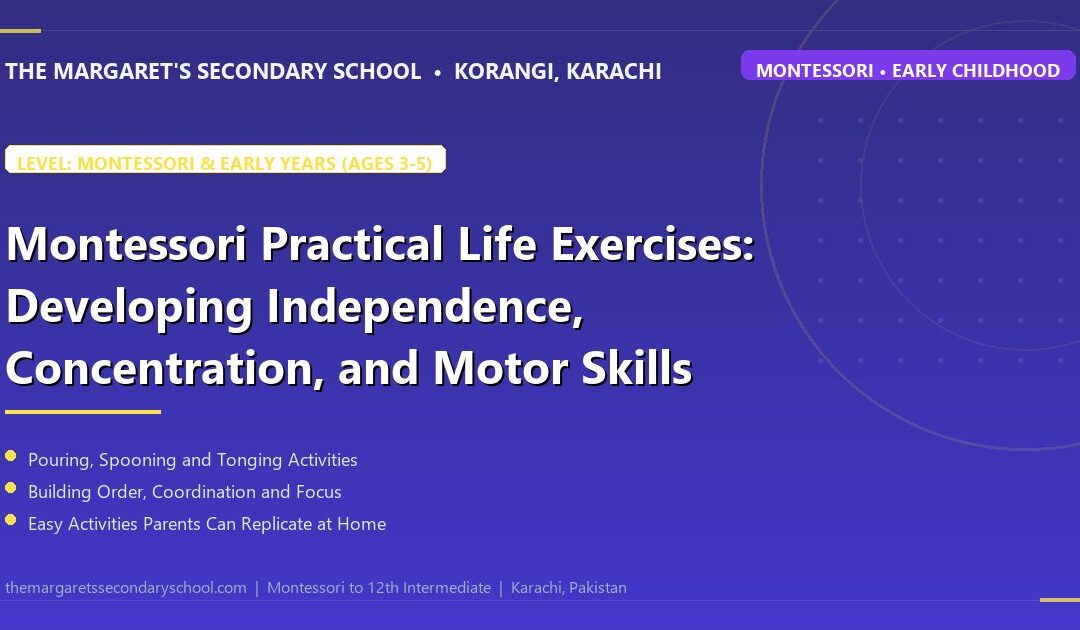
Academic Level: Montessori & Early Years (Ages 3-5) |
Subject: Montessori & Early Learning |
Institution: The Margaret’s Secondary School, Korangi, Karachi
Curriculum focus aligned with the Sindh Textbook Board, BSEK Matriculation, and BIEK Intermediate syllabus.
Discover how daily practical life exercises in the Montessori classroom lay the vital neurological groundwork for handwriting, self-discipline, and academic confidence in early childhood.
The Purpose of Practical Life in the Montessori Method
The Four Main Areas of Practical Life
- Care of Self: Buttoning, zipping, tying laces, washing hands, and food preparation.
- Care of the Environment: Sweeping with child-sized brooms, wiping spills, polishing wooden objects, and watering plants.
- Grace and Courtesy: Polite greeting rituals, saying ‘please’ and ‘thank you’, waiting one’s turn, and gentle conflict resolution.
- Control and Coordination of Movement: Walking on the line, carrying trays with both hands, and balancing delicate glassware.
How Practical Life Prepares Children for Writing and Reading
🎓 Key Academic Takeaways & Exam Strategies
- Review key terminology, formulas, and definitions on a weekly basis.
- Practice writing answers in neat bullet points to maximize marks in Board examinations.
- Consult with your subject teachers at The Margaret’s Secondary School for additional past-paper guidance and laboratory demonstrations.
Frequently Asked Questions (FAQs)
Q: Can practical life exercises be done at home?
Ans: Absolutely. Involve your child in folding small napkins, sorting socks by color, and pouring water from a small child-friendly jug.
Q: At what age do children transition from practical life to academic subjects?
Ans: Practical life remains beneficial throughout early childhood, but children naturally begin combining it with sensorial and language materials between ages 3.5 and 4.5.
Related posts:
 Phonics and Sensory Learning: Nurturing Early Reading and Motor Skills in Montessori Education
Phonics and Sensory Learning: Nurturing Early Reading and Motor Skills in Montessori Education
Phonics and Sensory Learning: Nurturing Early Reading and Motor Skills in Montessori Education
 Phonics and Sensory Learning: Nurturing Early Reading and Motor Skills in Montessori Education
 Sensorial Education in the Montessori Method: Refining the Senses for Intellectual Growth